You’ve filed your federal return, claimed the FEIE or FTC, and dealt with FBAR and the other international forms. But there’s one more layer many Americans in Japan overlook: state taxes.
Moving to Japan does not automatically end your state tax obligations. Some states may continue to consider you a resident and tax your worldwide income until you properly establish a new domicile. The rules — including safe harbors, FEIE conformity, and nonresident source taxation — vary significantly by state.
This article is general information and is not tax, legal, or accounting advice. State tax residency is a fact-specific determination that depends on each state’s current rules. Consult a qualified tax professional familiar with the specific state.
Why State Taxes Don’t Disappear When You Move Abroad
Federal tax residency for US citizens is based on citizenship. State tax residency, by contrast, is based on domicile and/or statutory residency — concepts that depend on where you maintain your permanent home, your intent to return, and your continuing connections to the state.
Simply moving to Japan does not change your domicile in many states unless you take affirmative steps to establish a new domicile. However, specific safe harbors and rules may apply depending on your state and circumstances.
Domicile vs. Statutory Residency
Most states use one or both of these concepts:
Domicile
Your domicile is your permanent, legal home — the place you intend to return to when you’re away. You can have only one domicile at a time. Once established, a domicile continues until you establish a new one. Factors states commonly examine include:
- Where you own or rent a home and whether it is available for your use
- Where your family lives
- Where you hold a driver’s license
- Where your bank accounts, financial advisors, and professional relationships are
- Where you receive mail and keep personal belongings
- Your stated intent (on tax returns, legal documents, etc.)
- The nature and duration of your absence
Statutory Residency
Some states have statutory residency rules that can make you a tax resident based on the number of days you spend in the state combined with maintaining a place of abode, even if you are not domiciled there.
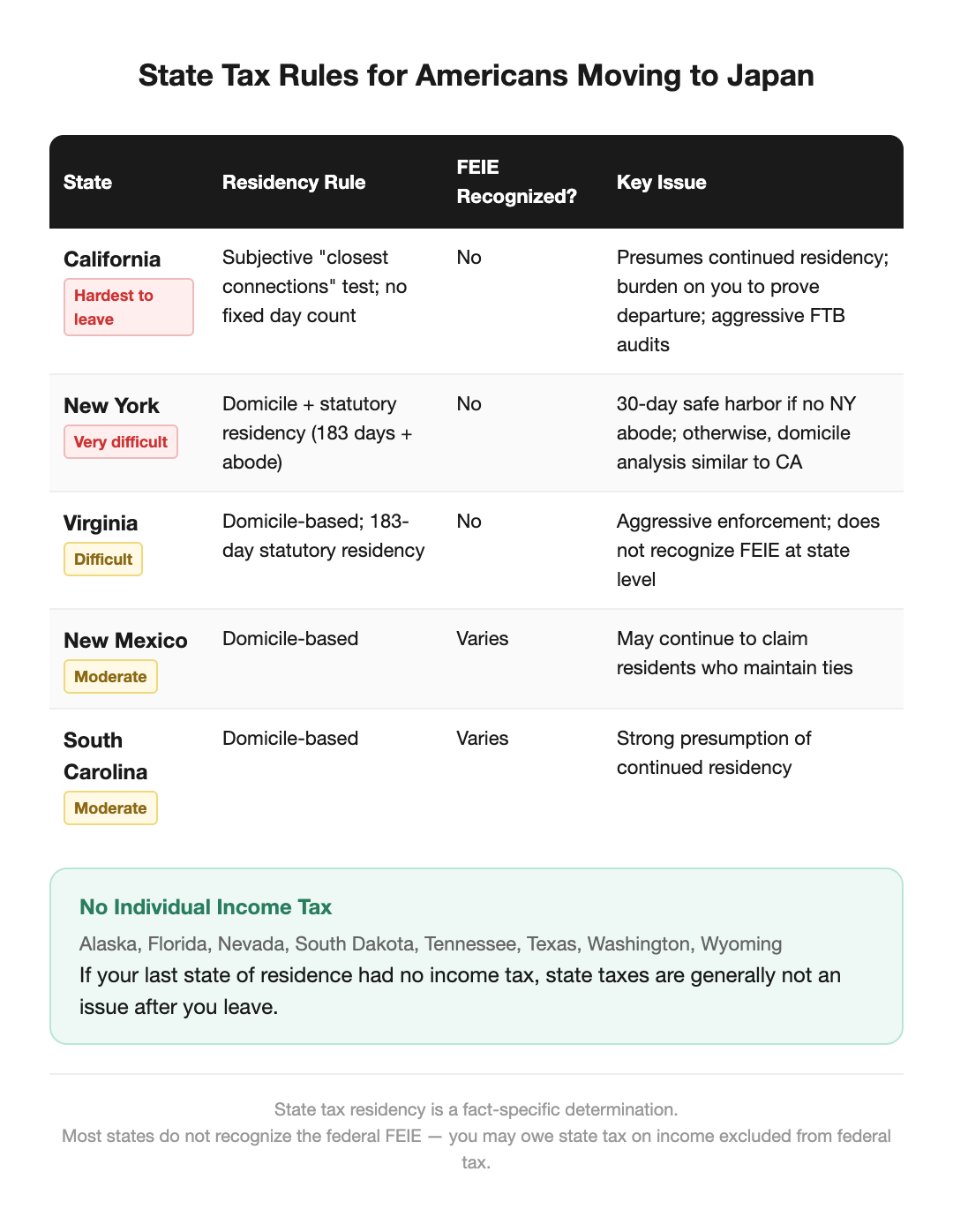
State-Specific Rules for Key States
California
California generally uses a facts-and-circumstances test to determine residency, but specific presumptions and safe harbors also apply.
- Facts-and-circumstances test: California examines the “closest connections” to determine whether you left for temporary/transitory purposes or permanently. Factors include home availability, family, employment, financial accounts, and more
- 9-month presumption: An individual present in California for more than 9 months aggregate during the tax year is presumed to be a resident (rebuttable)
- 546-day safe harbor: A California domiciliary working abroad under a qualifying employment-related contract for at least 546 consecutive days may be treated as a nonresident during the safe harbor period, subject to conditions including spending no more than 45 days in California per year and not having certain intangible income above $200,000. This safe harbor applies even if the individual maintains a California home (rented out), driver’s license, bank accounts, and voter registration
- Section 911 FEIE: California generally adds the federal Form 2555 exclusion back to income on Schedule CA. This means income excluded from federal tax under the FEIE may still be included in California taxable income if California considers you a resident
Source: FTB Pub. 1100 — Taxation of Nonresidents and Individuals Who Change Residency | FTB Publication 1031 — Guidelines for Determining Resident Status
New York
New York uses both domicile and statutory residency, with specific safe harbors for overseas residents:
- Domicile: Once domiciled in New York, you remain domiciled until you clearly establish domicile elsewhere
- Statutory residency: You are a statutory resident if you maintain a permanent place of abode in New York for substantially all of the taxable year and spend 184 or more days in the state
- 30-day safe harbor: If you are domiciled in New York but maintain no permanent place of abode in the state, maintain a permanent place of abode outside the state, and spend 30 days or fewer in New York during the tax year, you may be treated as a nonresident
- 548-day rule (Group B): A New York domiciliary may qualify for nonresident treatment for a period of 548 consecutive days if the individual is present in one or more foreign countries for at least 450 days during that period, the individual, spouse, and minor children satisfy the 90-day New York limit, and the prorated limits for the beginning and ending tax years are met
- Section 911 FEIE: New York generally begins with federal AGI (which already reflects the FEIE) and does not add the exclusion back. The FEIE is generally recognized for New York purposes
- Convenience-of-the-employer rule: Former New York residents working remotely from Japan for a New York employer should analyze New York’s telecommuting sourcing rule. If the primary office is in New York and the Japan home office does not qualify as a bona fide employer office, telework days may be sourced to New York even after you become a nonresident
Source: New York — Income Tax Definitions | New York — Residency and Telecommuting FAQs
Virginia
- Domicile: Virginia domicile continues until you actually acquire a new domicile in another jurisdiction and abandon your Virginia domicile. Moving to Japan and establishing domicile there can end Virginia domicile
- Actual resident: A person who maintains a place of abode in Virginia and is present in Virginia for more than 183 days during the tax year is an actual resident
- Section 911 FEIE: Virginia generally begins with federal AGI and allows the federal Section 911 exclusion. The FEIE is generally recognized for Virginia purposes
Source: Virginia Tax — Residency Status
FEIE Recognition Varies by State
State treatment of the federal Section 911 exclusion (FEIE) varies significantly:
- California: Generally adds the FEIE back — income excluded federally may still be taxable for California residents
- New York: Generally starts from federal AGI (which reflects the FEIE) and does not add it back
- Virginia: Generally starts from federal AGI and allows the FEIE
Each state has its own IRC conformity rules and specific modifications. Do not assume that your state follows the same treatment as another state. Check the state’s current conformity rules, addback schedules, and modification instructions for the tax year being filed.
What Happens If Your State Still Claims You as a Resident
If your former state considers you a continuing resident:
- You may owe state income tax on your worldwide income — including your Japanese salary
- Whether the FEIE reduces your state tax base depends on the state’s conformity rules (see above)
- A state resident credit for Japanese tax is often unavailable. California and New York, for example, generally limit their resident credits to taxes paid to specified US jurisdictions (New York provides a separate limited rule for Canadian provinces). Do not assume the federal FTC result carries over to the state return
- Penalties and interest accrue on unfiled state returns. In many states, the assessment limitation period does not begin until a required return is filed — do not assume a fixed number of years limits the state’s reach
Establishing Nonresidency: Evidence, Not a Checklist
State tax residency is determined by the totality of facts and circumstances — and state-specific safe harbors where applicable. Rather than a mandatory checklist, focus on building evidence in these categories:
Evidence of New Japanese Domicile
- Japanese residence card (在留カード)
- Japanese apartment lease or home purchase
- Registration with local government (住民登録)
- Japanese driver’s license
- Employment contract with a Japan-based employer
- Japanese tax filings
- Utility bills and bank accounts in Japan
Weakening Ties to Former State
- Surrendering or not renewing the state driver’s license (not required in all states or safe harbors, but a common factor)
- Changing address with financial institutions and government agencies
- Selling or renting out former state property (renting out does not disqualify California’s 546-day safe harbor)
- Minimizing return visits to the former state (day counts matter in some states’ safe harbors)
Voting from Abroad
If voting from abroad, use the UOCAVA / Federal Post Card Application process. Requesting a federal-only ballot where available generally does not affect state tax status. Voting in state or local elections may have different implications depending on the state. Consult the Federal Voting Assistance Program for details.
State-Specific Safe Harbors and Declarations
Check whether your state offers a safe harbor for overseas residents (such as California’s 546-day rule or New York’s 548-day rule) and file any required forms or declarations. These safe harbors may allow nonresident treatment even while maintaining certain ties to the state.
States Without a Broad-Based Individual Income Tax
If your last state of residence was one of the following, state income tax obligations are generally limited:
Alaska, Florida, Nevada, New Hampshire, South Dakota, Tennessee, Texas, Washington, Wyoming
However, these states may still impose other taxes. Washington, for example, imposes a capital gains excise tax on certain Washington-allocated long-term gains. New Hampshire’s Interest and Dividends Tax was repealed effective January 1, 2025. Nonresident source obligations may also apply if you retain state-source income. Federal treaty treatment does not automatically apply at the state level.
Filing Obligations After Establishing Nonresidency
Even after establishing nonresidency, you may still need to file state returns if:
- You have state-source income (rental income from property in the state, state-sourced wages under convenience-of-the-employer rules, state-based business income, etc.)
- You were a part-year resident during the transition year
- Your former state requires a nonresident return for certain types of income
The filing requirements vary by state. Check your former state’s tax authority website or consult a tax professional.
Frequently Asked Questions
I moved to Japan from California 3 years ago but still own a house there. Am I still a California resident?
Not necessarily. California’s 546-day employment-related safe harbor may apply if all statutory conditions are met. FTB Publication 1031 includes an example in which a taxpayer qualified while retaining and renting out a California home and maintaining other California ties, but no single fact guarantees the result. Outside the safe harbor, California examines the totality of circumstances — the determination depends on all facts.
Does the FEIE help with state taxes?
It depends on the state. California generally adds the FEIE back, so income excluded federally may still be taxable by California. New York and Virginia generally start from federal AGI (which reflects the FEIE) and do not add it back. Always check the specific state’s current conformity and modification rules.
I moved to Japan from Texas. Do I need to worry about state taxes?
Texas has no broad-based individual income tax. If you have no Texas-source income subject to other taxes, state income tax obligations are generally not an issue. Similar principles apply to the other states listed above, although special taxes (such as Washington’s capital gains excise tax) and state-source obligations may still apply.
Can I change my domicile to a no-income-tax state before moving to Japan?
Some people attempt to establish domicile in a no-income-tax state (such as Florida or Texas) before moving abroad. This can work, but it must be a genuine change of domicile — you generally need to actually live in the new state, establish real connections there, and sever ties with the old state. The requirements are fact-specific and state-specific.
What if I’ve been abroad for years and never filed a state return?
If your former state considers you a continuing resident, you may have unfiled returns with accruing penalties and interest. In many states, the assessment limitation period does not begin until a required return is filed. Do not self-determine the number of years at issue — consult a tax professional familiar with your specific state’s rules, including any voluntary disclosure programs.
I work remotely from Japan for a New York employer. Is that income New York-source?
Potentially. Under New York’s convenience-of-the-employer rule, telework days from Japan may be sourced to New York if your primary office is in New York and your Japan workspace does not qualify as a bona fide employer office. Ending New York residency does not necessarily eliminate New York-source wage taxation. Analyze the rule carefully or consult a tax professional.
Next Steps
- US Tax Filing Obligations — The complete overview
- FEIE — Federal exclusion (state treatment varies)
- Foreign Tax Credit — Federal credit (generally does not carry over to state returns for foreign taxes)
- Streamlined Filing — How to catch up on federal filings (coming soon)