If you’re an American living in Japan and you’ve failed to report income from foreign financial assets and pay the related tax — and may also have missed related FBARs or international information returns — and these failures resulted from non-willful conduct — the IRS offers a path to get compliant.
The Streamlined Filing Compliance Procedures may be available to eligible taxpayers whose non-willful conduct involved a failure to report income from a foreign financial asset and pay tax as required by US law, and who may also have failed to file related FBARs or international information returns. For Americans living in Japan, the Streamlined Foreign Offshore Procedures (SFOP) are typically the applicable track. They are not a general amnesty program for every type of delinquent return.
This article is general information and is not tax, legal, or accounting advice. The Streamlined Procedures have specific eligibility requirements and involve certification under penalties of perjury. Consult a qualified tax professional before submitting.
What Are the Streamlined Procedures?
The Streamlined Filing Compliance Procedures allow certain taxpayers to file delinquent or amended tax returns and delinquent FBARs with reduced or no penalties. The program has two tracks:
| Streamlined Foreign Offshore (SFOP) | Streamlined Domestic Offshore (SDOP) | |
|---|---|---|
| For | US taxpayers residing outside the US | US taxpayers residing in the US |
| Penalty | Generally no penalty (if all requirements met) | 5% miscellaneous offshore penalty on certain foreign financial assets |
| Non-residency test | Must meet the applicable non-residency requirement | Does not meet the non-residency requirement |
| Certification | Form 14653 | Form 14654 |
| Prior returns filed? | Not required — original or amended returns accepted | Must have previously filed required US tax returns for the 3-year period |
For Americans living in Japan, the SFOP is typically the applicable track.
Source: IRS — Streamlined Filing Compliance Procedures
Who Is Eligible?
To use the Streamlined Foreign Offshore Procedures, you must meet all of the following:
1. Individual Taxpayer (or Estate)
The procedures are available to individual US taxpayers, including estates of individual taxpayers. They are not available to corporations or partnerships. Returns must include a valid taxpayer identification number (SSN or ITIN). A taxpayer who is ineligible for an SSN and does not yet have an ITIN may submit a complete ITIN application with the Streamlined package.
2. Non-Residency Requirement
For US citizens and green card holders, you must demonstrate that in any one or more of the most recent 3 tax years for which the return due date (or properly applied for extended due date) has passed, you did not have a US abode and you were physically outside the United States for at least 330 full days.
For joint filers, both spouses must meet the applicable non-residency requirement. For individuals who are neither US citizens nor lawful permanent residents, a different test applies (based on not meeting the substantial presence test under IRC §7701(b)(3) in at least one of the 3 years).
Long-term residence in Japan may satisfy the citizen/LPR test, but “abode” is a separate facts-and-circumstances concept and should not be assumed from the 330-day count alone. Consult the IRS SFOP instructions for the complete definition.
3. Non-Willful Conduct
Your failures must have resulted from non-willful conduct. The IRS defines non-willful conduct as conduct due to negligence, inadvertence, or mistake, or conduct that is the result of a good faith misunderstanding of the requirements of the law.
You must certify this under penalties of perjury on Form 14653 (Certification by U.S. Person Residing Outside of the U.S.). The certification must include a specific, detailed narrative explaining why the failures occurred, covering all relevant facts and circumstances. If you relied on a professional adviser, Form 14653 requires the adviser’s name, address, telephone number, and a summary of the advice received.
4. Not Under Examination or Criminal Investigation
You cannot use the Streamlined Procedures if you are under civil examination or criminal investigation by the IRS for any tax year.
5. Prior Streamlined Submission
If you discover an error in a prior SFOP submission and the submitted returns are not under examination, the IRS FAQ (Q9) permits correction with amended returns and/or an amended Form 14653. Specific labeling is required: write “amended” on the amended Form 14653, and “Amended Streamlined Foreign Offshore” on the first page of each corrected amended tax return. Include a full explanation of the original error and the facts and circumstances. Amended FBARs, if needed, are filed electronically with FinCEN. Consult the current SFOP FAQs for details.
Source: IRS — U.S. Taxpayers Residing Outside the United States
What Must You File?
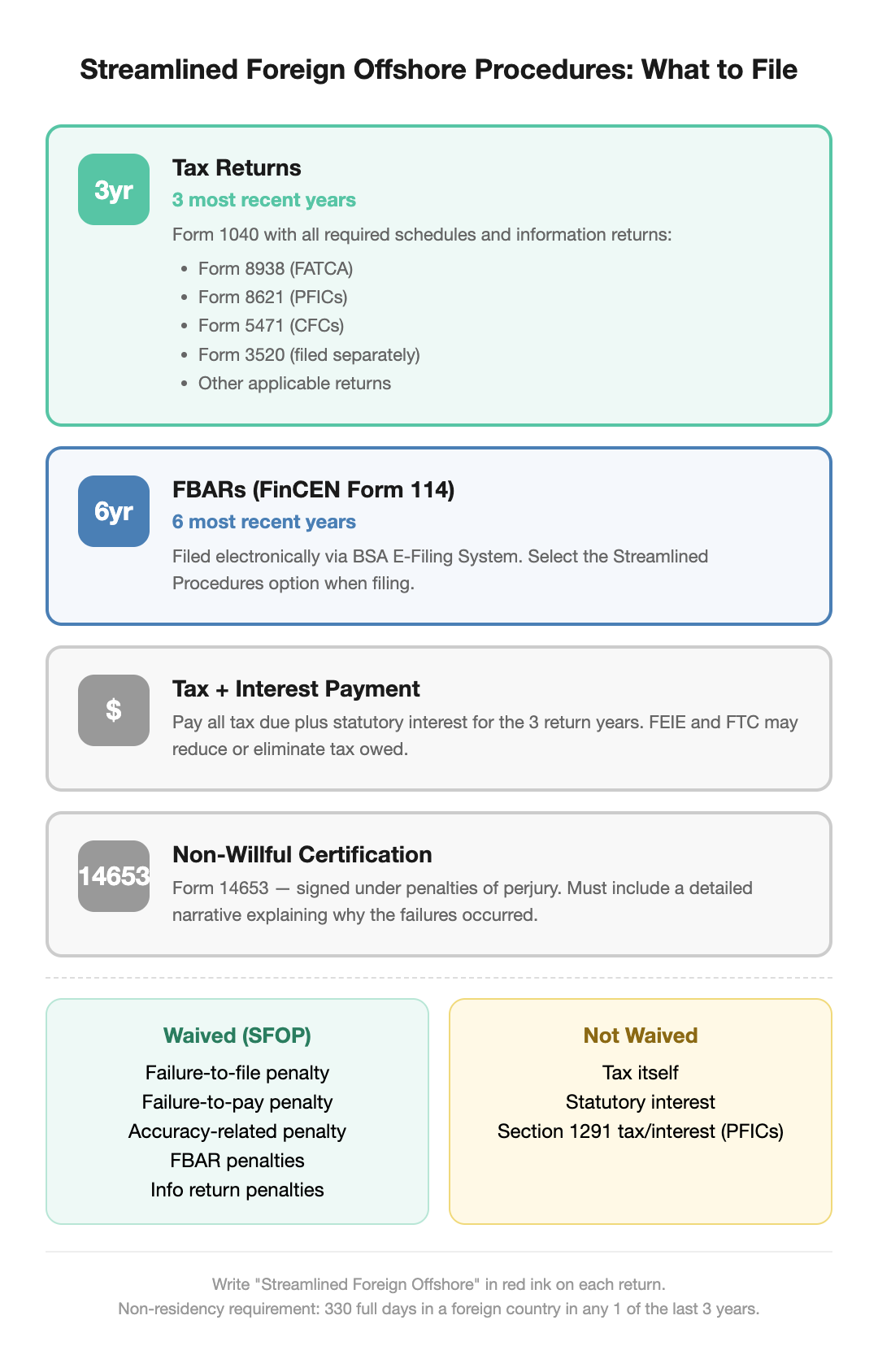
Under the SFOP, you must submit:
Tax Returns: 3 Years
File income tax returns (Form 1040, with all required schedules and information returns) for the most recent 3 tax years for which the return due date (or properly applied for extended due date) has passed. If you are filing returns for the first time, these will be original returns. If you previously filed but need to correct them, file amended returns (Form 1040-X).
Include all required information returns with the Streamlined submission package, even forms that would ordinarily be filed separately under their normal instructions. This may include:
- Form 8938 (FATCA)
- Form 8621 (PFICs) — may be required for each PFIC, subject to applicable exceptions
- Form 5471 (CFCs) — may be required depending on ownership and filer category
- Form 3520 (foreign trusts/gifts) — included with the Streamlined package, not filed separately
- Any other applicable international information returns
FBARs: 6 Calendar Years
File FBARs (FinCEN Form 114) for the most recent 6 calendar years for which the FBAR due date has passed. FBARs are filed electronically through the BSA E-Filing System. On the FBAR cover page, select “Other” as the reason for filing late and enter “Streamlined Filing Compliance Procedures” in the explanation box.
Payment
Pay all tax due, plus statutory interest, for each of the 3 return years. Use the IRS interest rates for the applicable periods.
Form 14653 and Submission Procedures
- Complete and sign the original Form 14653, including the detailed narrative statement
- Include the original signed Form 14653 in the submission package
- Attach a copy of Form 14653 to each delinquent or amended tax return and each information return in the package
- Write “Streamlined Foreign Offshore” in red ink at the top of each delinquent or amended return and each information return
- Mail the package to the IRS address specified in the current SFOP instructions — verify the address before mailing, as it may change
Source: IRS — U.S. Taxpayers Residing Outside the United States
What Penalties Are Addressed?
Under the SFOP, if all eligibility and submission requirements are met, the following penalties are generally not imposed:
- Failure-to-file penalty
- Failure-to-pay penalty
- Accuracy-related penalty
- FBAR penalties
- Applicable information return penalties
However, Streamlined submissions are processed like other returns and may be selected for examination or verification. An inaccurate or incomplete submission may result in additional tax, penalties, and potential criminal liability.
What is not waived:
- Statutory interest on unpaid tax — interest accrues from the original due date
- Tax itself — you must pay all tax due for the 3 return years
- Section 1291 tax and interest (PFICs) — the Streamlined Procedures do not change the Section 1291 excess-distribution tax-and-interest calculation
Common Situations for Americans in Japan
“I Didn’t Know I Had to File”
A common scenario. You moved to Japan, paid Japanese taxes, and were unaware of your US filing obligations. The Streamlined Procedures may address this situation — but you must explain your specific circumstances in detail in the Form 14653 narrative, including how and when you became aware of the obligations.
“I Filed Returns but Missed FBARs and Information Returns”
You filed Form 1040 each year but didn’t know about FBARs, Form 8938, Form 8621 (for your Japanese investment trusts), or other international forms. If the filed returns also omitted income from foreign financial assets and related tax, SFOP may cover amended returns, required information returns, and delinquent FBARs. If all income was reported and all tax was paid, the Delinquent FBAR or Delinquent International Information Return Submission Procedures may be more appropriate.
“I Have Japanese Investment Trusts (PFICs)”
If you hold Japanese investment trusts that may be PFICs, the Streamlined Procedures may require filing Form 8621 for applicable PFICs for the 3 return years. Under Section 1291 (the default regime), excess distributions and disposition gains are subject to the tax-and-interest calculation even within the Streamlined submission. The procedures do not alter the Section 1291 tax-and-interest calculation.
“I Own a Japanese Company (KK)”
If you own a Japanese KK that is a CFC, Form 5471 may be required depending on your filer category for the 3 return years. Subpart F income and GILTI or NCTI inclusions (depending on the CFC tax year) must be calculated and reported. The Streamlined Procedures waive Form 5471 penalties but do not waive the underlying tax on CFC inclusions.
Streamlined vs. Other Options
The Streamlined Procedures are not the only path to compliance. Depending on your situation, other options may be more appropriate:
- Delinquent FBAR Submission Procedures — If you have properly reported all income on your tax returns, paid all tax, are not under examination or criminal investigation, and have not been contacted by the IRS about the delinquent FBARs, the IRS states it will not impose a penalty. File late FBARs electronically with a statement explaining the reason for the late filing. This is narrower in scope than Streamlined but simpler if you meet all conditions
- Delinquent International Information Return Submission — For taxpayers who failed to file information returns (Form 5471, 8938, 8621, 3520, etc.) but have no unreported income, filing through normal procedures with a reasonable-cause statement may be appropriate. Penalties may still be assessed initially
- Relief Procedures for Certain Former Citizens — For certain former US citizens who meet specific requirements
- Voluntary Disclosure Practice — A potential option for willful conduct. A timely, truthful, and complete disclosure with full cooperation may reduce criminal-prosecution risk, but it does not provide an unconditional guarantee of immunity and generally involves substantial tax, interest, and penalties
Frequently Asked Questions
I’ve been in Japan for 10 years and never filed. Can I use the Streamlined Procedures?
Potentially, if your failures involved unreported income from foreign financial assets and unpaid related tax, and you meet all other eligibility requirements — including the non-residency test and non-willful certification. If you only missed FBARs or information returns but properly reported all income and paid all tax, other procedures (such as the Delinquent FBAR or Delinquent International Information Return Submission Procedures) may be more appropriate. You would file 3 years of returns and 6 years of FBARs. The SFOP submission package generally covers the specified 3-year return period and 6-year FBAR period. That limited package does not necessarily eliminate filing obligations or exposure for earlier years. Obtain case-specific advice before deciding how to address older delinquent returns. Consult a tax professional for your specific situation.
Do I need to pay tax even though I already paid Japanese tax?
You must calculate your US tax liability for each of the 3 return years. The FEIE may reduce US tax on qualifying foreign earned income, while the FTC may reduce US tax on eligible foreign-source income, subject to their separate rules and limitations. If no US tax is due after applying these provisions, there is no underpayment interest on that tax. However, other items — such as Section 1291 PFIC tax and interest, or tax on income not covered by the FEIE or FTC — may result in amounts due. You must still complete and file the returns and information returns regardless.
What if my conduct was willful?
The Streamlined Procedures are only for non-willful taxpayers. If you knew about your filing obligations and deliberately chose not to file, the Streamlined Procedures are not available. The IRS Voluntary Disclosure Practice may be an alternative, though it generally involves substantial penalties and does not guarantee immunity from criminal prosecution. Consult a tax attorney.
Can I use the Streamlined Procedures for state taxes?
No. The Streamlined Procedures are a federal IRS program. State tax obligations must be addressed separately with each applicable state. See our State Tax article for more information.
How long does the process take?
The IRS does not publish a specific processing timeline. Streamlined returns are processed like other returns; receipt is generally not acknowledged, and the process does not end with a closing agreement. A submission is not automatically audited, but it may be selected for examination or verification. The IRS may contact you if it has questions about your submission or Form 14653 narrative.
What if I’ve already filed some years but not others?
You can file original returns for the missing years and amended returns for years where corrections are needed. The 3-year window covers the most recent years for which the return due date (or properly applied for extended due date) has passed. FBARs cover the most recent 6 calendar years.
Next Steps
- US Tax Filing Obligations — Understand what you need to file going forward
- FBAR Filing — Report your Japanese financial accounts
- PFICs and Form 8621 — Japanese investment funds and PFIC reporting
- Form 5471 — If you own a Japanese company
- State Tax — State obligations must be addressed separately