If you’re an American living in Japan and you sell the home you’ve been living in, you may be able to exclude up to $250,000 of capital gains from US federal income tax — or up to $500,000 if you’re married filing jointly and both spouses meet the applicable requirements. This is the Section 121 principal residence exclusion, and it applies to foreign properties just as it does to homes in the United States.
However, selling a home in Japan as a US person involves complications that don’t arise in a domestic sale: currency conversion for both basis and sale proceeds, potential foreign currency mortgage gain, Japanese capital gains tax (including for nonresidents), and the interaction with the Foreign Tax Credit.
This article is general information and is not tax, legal, or accounting advice. Real estate transactions involve both US and Japanese tax obligations. Consult qualified tax professionals in both jurisdictions.
The Section 121 Exclusion: Basics
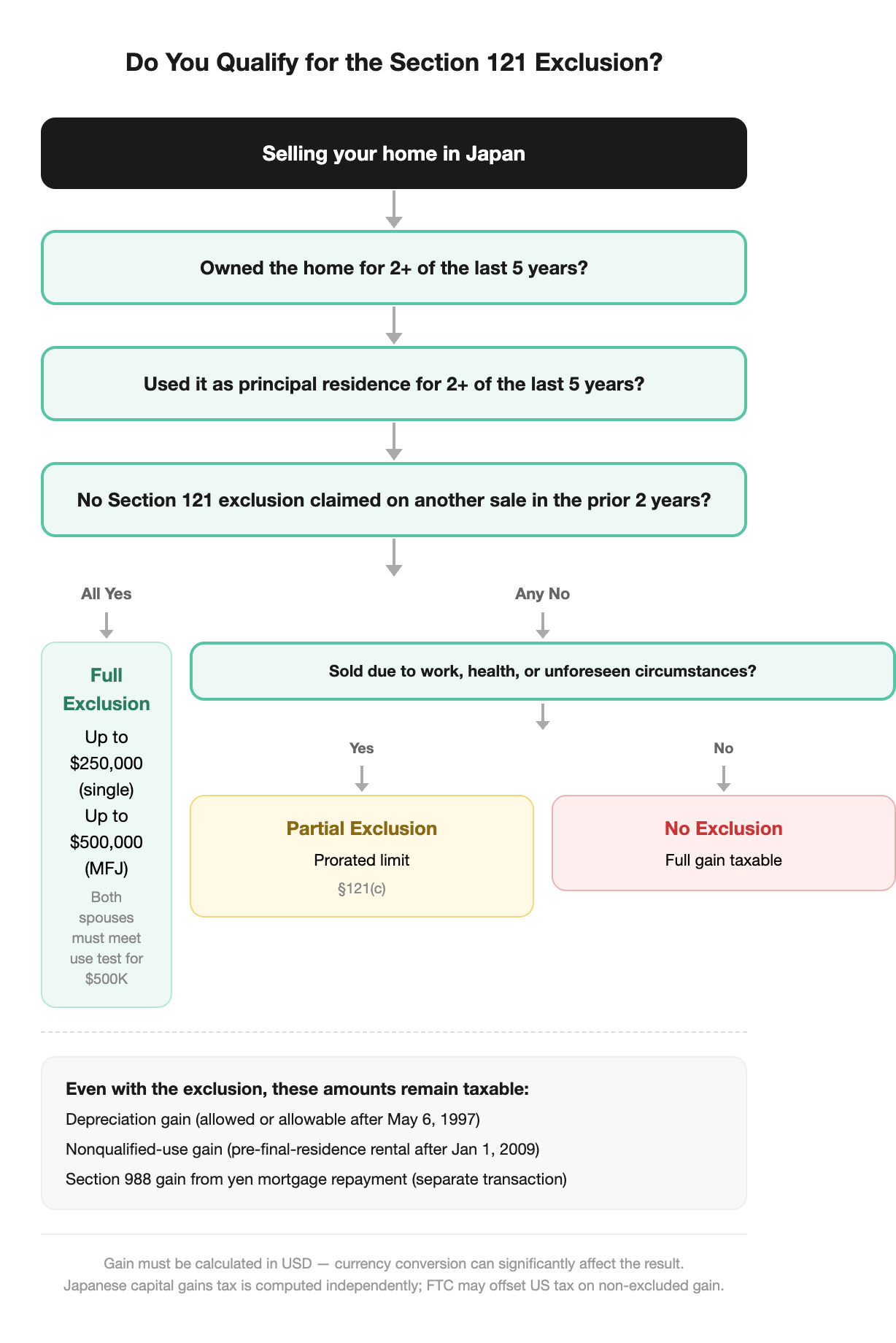
Under IRC Section 121, you may exclude from gross income up to:
- $250,000 of gain (single filers)
- $500,000 of gain (married filing jointly)
For the full $500,000 MFJ exclusion, both spouses must meet the use test, at least one must meet the ownership test, and neither spouse may have claimed the Section 121 exclusion on another home sale within the 2 years preceding this sale. If the full $500,000 requirements are not met, each spouse’s exclusion is calculated separately — the result is not necessarily a flat $250,000. See IRS Publication 523, Worksheet 1 for the calculation.
To qualify for the full exclusion, you must meet both:
1. Ownership Test
You owned the home for at least 2 of the 5 years before the date of sale.
2. Use Test
You used the home as your principal residence for at least 2 of the 5 years before the date of sale. The 2 years do not need to be consecutive.
In addition, you generally cannot claim the full exclusion if you excluded gain from another principal-residence sale during the 2-year period ending on the date of the current sale. Certain other disqualifications may also apply, including homes acquired through a Section 1031 exchange within the prior 5 years and certain expatriates to whom the special rule in Section 121(e) applies.
Partial Exclusion for Work, Health, or Unforeseen Circumstances
Even if you do not meet the full ownership, use, or look-back requirements, you may qualify for a reduced (partial) exclusion under Section 121(c) when the primary reason for the sale is a work-related move, health issue, or qualifying unforeseen circumstance. This is particularly relevant for Americans in Japan who may sell due to a job transfer, relocation, or family situation. The reduced exclusion limit is generally prorated under the rules in IRS Publication 523.
Source: 26 U.S.C. §121 | IRS — Publication 523, Selling Your Home
Does It Apply to a Home in Japan?
Yes. Section 121 applies to the sale of a principal residence regardless of the property’s location. If your home in Japan is your principal residence and you meet the ownership and use tests, you may claim the exclusion.
The IRS determines principal residence based on facts and circumstances, including:
- Where you live most of the time
- Your place of employment
- Where your family lives
- The address on your tax returns, driver’s license, voter registration, and other documents
- Where your bank accounts and personal belongings are located
For most Americans living and working in Japan, the home they occupy in Japan is their principal residence.
Calculating the Gain on a Japanese Property
The gain calculation for US tax purposes must be done in US dollars. This creates a currency conversion issue that can significantly affect the result.
Step 1: Determine Your Adjusted Basis (in USD)
Your basis starts with the cost of acquiring the property (purchase price plus allowable closing costs, improvements, etc.), reduced by any depreciation allowed or allowable. Convert the yen amounts to USD using the exchange rate on the date of each transaction:
- Purchase price: convert at the exchange rate on the date of purchase
- Improvements: convert at the exchange rate on the date each improvement was paid
- Closing costs: convert at the applicable transaction dates. Not all Japanese closing costs automatically qualify as basis items under US tax rules — classify each item under the applicable US rules
- Depreciation allowed or allowable: reduces your basis
Step 2: Determine the Amount Realized (in USD)
Amount realized = Sale price minus selling expenses (broker commissions, legal fees, stamp duty paid by seller, etc.). Convert the sale price at the applicable sale-date rate and convert each selling expense using the rate applicable to that transaction or payment date.
Step 3: Calculate the Gain
Gain or loss = Amount realized (USD) − Adjusted basis (USD)
If the calculation produces a loss, a loss attributable to the personal-use portion of a principal residence is generally not deductible. A separately calculated business or rental portion may be subject to different rules.
Record the spot exchange rate and the legal transaction date for each conversion. For installment sales or delayed closings, consult a tax professional regarding the applicable dates and methods.
Foreign Currency Mortgage: A Separate Transaction
If you financed the purchase with a yen-denominated mortgage, the borrowing and repayment of the mortgage is treated as a separate transaction from the purchase and sale of the property for US tax purposes. Exchange rate changes between the time you borrowed and the time you repaid can create Section 988 foreign currency gain that is ordinary income — and this gain is not eligible for the Section 121 exclusion. However, under Section 988(e)(2), a personal-transaction gain is generally not recognized if the otherwise recognizable gain does not exceed $200.
A foreign currency loss on a personal mortgage is generally not deductible.
This is a common issue for Americans who take out a yen mortgage and later repay it from yen sale proceeds at a different exchange rate than when the loan was taken. Consult a tax professional for the calculation.
Source: 26 U.S.C. §988 — Treatment of Certain Foreign Currency Transactions | Quijano v. United States, 93 F.3d 26 (1st Cir. 1996)
Nonqualified Use
If you used the property for a purpose other than as your principal residence after January 1, 2009 — for example, you rented it out or used it as a vacation home — a portion of your gain may be allocable to nonqualified use and may not be eligible for the Section 121 exclusion.
Important: the period after the last date you used the property as your principal residence (before the sale) is not treated as nonqualified use. This means that if you lived in the home, moved out, and rented it until selling, the rental period after your final occupancy is generally not nonqualified use — though you must still meet the 2-of-5-year use test, and depreciation gain from the rental period cannot be excluded.
Rental or other nonresidential use before the property’s final period as your principal residence (after January 1, 2009) may be nonqualified use. However, exceptions include certain periods of qualified official extended duty (up to 10 years aggregate) and temporary absences of up to 2 years in the aggregate due to employment, health, or qualifying unforeseen circumstances. These temporary-absence exceptions reduce nonqualified-use days and are separate from the Section 121(c) partial exclusion for sales that do not meet the full tests.
The nonqualified-use gain is generally calculated by multiplying the gain remaining after removing post-May 6, 1997 depreciation gain by the ratio of nonqualified-use days after 2008 to total ownership days. Use IRS Publication 523, Worksheet 3 for the actual calculation.
Source: IRS — Publication 523, Selling Your Home
Depreciation Recapture
If you rented out your Japanese home at any point, gain attributable to depreciation allowed or allowable for periods after May 6, 1997 cannot be excluded under Section 121 — even if you never actually claimed the depreciation deduction.
For depreciable residential real property, some gain may be ordinary Section 1250 recapture, while other depreciation-related gain may be unrecaptured Section 1250 gain subject to a maximum 25% rate. If the business or rental portion was physically separate from the residential portion, Form 4797 and a separate gain calculation may be required.
Japanese Tax on the Sale
Japan taxes capital gains on Japanese real property whether the seller is a Japanese tax resident or a nonresident.
Residents
- Short-term (owned 5 years or less as of January 1 of the year of sale): approximately 39.63% (income tax + resident tax + special reconstruction tax)
- Long-term (owned more than 5 years as of January 1 of the year of sale): approximately 20.315%
- A reduced rate may apply for certain owner-occupied residential properties held more than 10 years
Japan also has its own principal residence exclusion (居住用財産の3,000万円特別控除), which may reduce or eliminate the Japanese capital gains tax, subject to detailed eligibility and filing requirements. See NTA No. 3302 for the conditions.
Nonresidents
A payment to a nonresident seller is generally subject to 10.21% withholding (subject to statutory exceptions — for example, when the buyer acquires the property for personal or family residential use and the consideration is ¥100 million or less). See NTA No. 1932 for details. The withholding is reconciled through the Japanese tax filing process, and overpayment may be refunded. Nonresidents may need to appoint a tax agent (納税管理人) in Japan. Consult a Japanese tax professional if you plan to sell after leaving Japan.
The Japanese tax and US tax are computed independently under each country’s rules.
Source: 国税庁 No.1440 — 土地や建物を譲渡したとき | 国税庁 No.3302 — マイホームの3,000万円特別控除
Foreign Tax Credit for Japanese Capital Gains Tax
If you pay Japanese capital gains tax on the sale, you may be able to claim a Foreign Tax Credit on your US return to offset the US tax on the same gain. The FTC is claimed on Form 1116.
Key considerations:
- The FTC can offset your regular US income tax on the gain, but it is subject to the Section 904 limitation and the applicable income-category (basket) rules
- The Section 121 exclusion reduces your US taxable gain first. The FTC then applies to any remaining US tax on the non-excluded portion
- If the Section 121 exclusion eliminates all of your US taxable gain, there may be little or no current-year FTC limitation from the sale. Whether any Japanese tax remains creditable and creates a carryover requires allocation of the tax under the FTC rules — do not assume that the full Japanese tax is automatically available for carryover
- The FTC generally does not offset the NIIT (see our NIIT article)
- The Japanese and US tax bases (gain amounts) will differ due to differences in basis calculations, selling expenses, currency conversion, and each country’s residential exclusion
Source: IRS — Foreign Tax Credit | IRS — Publication 514, Foreign Tax Credit for Individuals
Reporting the Sale
Whether you must report the sale on your US return depends on the circumstances. You generally must report if:
- You have taxable gain — including gain above the exclusion limit, nonqualified-use gain, depreciation-related gain that cannot be excluded, or gain from a separately calculated business or rental portion
- You received a Form 1099-S (unlikely for a Japanese property, but possible)
- You choose not to use the exclusion
- Depreciation recapture or a business/rental portion requires Form 4797
A fully excluded sale where none of the above applies generally does not need to be reported on Schedule D. However, if you paid Japanese capital gains tax and want to claim an FTC, you must file Form 1116.
Forms that may be required:
- Form 8949 and Schedule D — report the sale and the exclusion (when reporting is required)
- Form 4797 — may be required for depreciation-related gain or a separately calculated business or rental portion
- Form 1116 — if claiming a Foreign Tax Credit for Japanese capital gains tax paid
- Form 8960 — the gain (to the extent not excluded under Section 121) may be subject to the 3.8% NIIT if your MAGI exceeds the applicable threshold
Practical Considerations for Americans in Japan
Record Keeping
Maintain records of:
- Purchase contract and closing documents (in yen, with exchange rates and dates)
- Receipts for improvements and renovations (with dates and yen amounts)
- Selling expenses (commissions, legal fees, stamp duty, etc.)
- Exchange rates used for each conversion (spot rate on the legal transaction date)
- Dates of occupancy as principal residence
- Any periods of rental use and depreciation allowed or allowable
- Mortgage borrowing and repayment records (for Section 988 analysis)
- Japanese tax returns showing capital gains tax paid
Timing Considerations
- If you plan to move out of your Japanese home before selling, ensure you still meet the 2-of-5-year use test at the time of sale
- If you rent out the property after moving, depreciation gain from the rental period cannot be excluded. The rental period after your final occupancy is generally not nonqualified use, but you must still meet the use test
- Japan’s holding-period determination (whether the property has been owned for more than 5 years as of January 1 of the year of sale) may differ from your preferred timing for US tax purposes
Married Couples with a Non-US Spouse
If you are married to a Japanese spouse who is not a US person, the $500,000 MFJ exclusion requires that both spouses meet the use test and at least one meets the ownership test. Filing status (MFJ, MFS, or head of household) and the non-US spouse’s election to be treated as a US resident for tax purposes can affect both the available exclusion and the applicable NIIT threshold. Consult a tax professional for your specific situation.
Frequently Asked Questions
I’ve lived in my Tokyo apartment for 8 years. Can I exclude the entire gain?
If you owned and used the apartment as your principal residence for at least 2 of the 5 years before the sale, and the gain does not exceed $250,000 ($500,000 MFJ if applicable), the exclusion may cover the entire gain. Currency conversion effects will determine the actual USD gain amount.
I bought my home when the yen was at ¥80/$ and now it’s ¥150/$. How does that affect my gain?
Your basis (in USD) will be relatively high because the yen was strong when you purchased. Your sale proceeds (in USD) will be relatively low because the yen is now weak. This currency effect may reduce or eliminate your USD-denominated gain — even if the yen price of the property increased. The Section 121 exclusion then applies to whatever USD gain remains.
I rented out my home for 2 years after moving out, then sold. Can I still use the exclusion?
Possibly. If the rental period occurred after the last date you used the property as your principal residence and before the sale, that period is generally not treated as nonqualified use. You must still satisfy the 2-of-5-year ownership and use tests at the time of sale. Gain attributable to depreciation allowed or allowable after May 6, 1997 cannot be excluded. Rental or other nonresidential use before the property’s final period as your principal residence may produce nonqualified-use gain.
I have a yen mortgage. Does paying it off from the sale proceeds affect my US tax?
Potentially. The mortgage borrowing and repayment is a separate transaction from the property sale for US tax purposes. If the exchange rate changed between when you took out the loan and when you repaid it, you may have Section 988 foreign currency gain (ordinary income, not eligible for Section 121), although a personal-transaction gain is generally not recognized if the otherwise recognizable gain does not exceed $200. A personal foreign currency loss is generally not deductible.
What about Japan’s ¥30 million special exclusion?
Japan’s principal residence exclusion (居住用財産の3,000万円特別控除) applies under Japanese tax law and may reduce or eliminate your Japanese capital gains tax, subject to eligibility conditions. It is independent of the US Section 121 exclusion. You can potentially benefit from both — the Japanese exclusion reduces your Japanese tax, and the US Section 121 exclusion reduces your US tax — but the FTC calculation must account for the differing treatment under each country’s rules.
Next Steps
- US Tax Filing Obligations — The complete overview
- Foreign Tax Credit — Offset US tax with Japanese taxes paid
- NIIT — The 3.8% surtax on investment income including real estate gains
- FBAR Filing — Report your Japanese financial accounts
- Streamlined Filing — How to catch up if you haven’t been filing (coming soon)