You’ve figured out how to calculate your landed cost for a single shipment. But what happens when you import the same product multiple times — and the cost is different every time?
This is the reality of importing from Japan. The yen-dollar exchange rate shifts. Shipping rates go up in peak season. A new tariff kicks in. Suddenly, the same product sitting on your shelf has three different costs depending on when you ordered it.
So when you sell one unit, what’s your cost of goods sold? The answer depends on which inventory costing method you use — and it directly affects your profit, your taxes, and your pricing decisions.
Why Import Costs Change Between Orders
If you import from the same Japanese supplier regularly, you’ve probably noticed that your per-unit landed cost is never quite the same. Here’s why:
- Exchange rate fluctuations — JPY/USD can move 10–15% in a single year. A product that costs ¥1,200 might be $8.00 one month and $8.80 the next.
- Shipping rate changes — Carrier rates adjust seasonally, and fuel surcharges fluctuate constantly.
- Tariff changes — Trade policy updates can raise or lower your duty rate overnight.
- Order size — Larger orders spread fixed costs (broker fees, handling) across more units, lowering per-unit cost.
The result: you have 150 units of the same product on your shelf, but they cost you $18, $20, and $22 per unit depending on the shipment.
When you sell one, which cost do you use?
The Three Inventory Costing Methods
There are three standard methods for assigning cost to inventory. Each gives you a different cost of goods sold (COGS), a different gross profit, and potentially a different tax bill.
Let’s use a running example:
| Shipment | Date | Units | Landed Cost / Unit | Total |
|---|---|---|---|---|
| 1st order | January | 50 | $18.00 | $900 |
| 2nd order | March | 50 | $20.00 | $1,000 |
| 3rd order | May | 50 | $22.00 | $1,100 |
Total: 150 units, $3,000 invested.
Now you sell 60 units at $30 each ($1,800 revenue). What’s your COGS?
Method 1: Weighted Average Cost
The simplest method. You calculate one average cost across all inventory, and use that for every unit sold.
Average cost = Total cost ÷ Total units = $3,000 ÷ 150 = $20.00 / unit
| Calculation | Amount | |
|---|---|---|
| Revenue | 60 × $30 | $1,800 |
| COGS | 60 × $20.00 | $1,200 |
| Gross Profit | $600 |
When to use it:
- Your products are interchangeable (you don’t track which specific unit came from which shipment)
- You want simplicity — one number, no tracking required
- Cost differences between shipments are moderate
Best for: Most small import businesses. If you’re using a spreadsheet to track inventory, this is the easiest method to implement.
Method 2: FIFO (First In, First Out)
FIFO assumes you sell your oldest inventory first. The cost of the first units purchased is the cost assigned to the first units sold.
For 60 units sold:
- First 50 units → from Shipment 1 at $18.00 = $900
- Next 10 units → from Shipment 2 at $20.00 = $200
| Calculation | Amount | |
|---|---|---|
| Revenue | 60 × $30 | $1,800 |
| COGS | (50 × $18) + (10 × $20) | $1,100 |
| Gross Profit | $700 |
When to use it:
- Your products have a shelf life or you physically sell older stock first
- You want your balance sheet inventory value to reflect recent (current) costs
- Required or preferred under IFRS (International Financial Reporting Standards)
Watch out: When costs are rising (which is common with a weakening yen), FIFO assigns the lowest costs to COGS. This means higher reported profit — and higher taxes.
Method 3: LIFO (Last In, First Out)
LIFO assumes you sell your newest inventory first. The cost of the most recent purchase is assigned to units sold.
For 60 units sold:
- First 50 units → from Shipment 3 at $22.00 = $1,100
- Next 10 units → from Shipment 2 at $20.00 = $200
| Calculation | Amount | |
|---|---|---|
| Revenue | 60 × $30 | $1,800 |
| COGS | (50 × $22) + (10 × $20) | $1,300 |
| Gross Profit | $500 |
When to use it:
- You want to minimize taxable income when costs are rising
- Your business is US-based (LIFO is allowed under US GAAP)
Side-by-Side Comparison
Here’s how the three methods compare for the same 60 units sold:

| Method | COGS | Gross Profit | Remaining Inventory Value |
|---|---|---|---|
| Weighted Average | $1,200 | $600 | $1,800 (90 × $20) |
| FIFO | $1,100 | $700 | $1,900 (40 × $20 + 50 × $22) |
| LIFO | $1,300 | $500 | $1,700 (50 × $18 + 40 × $20) |
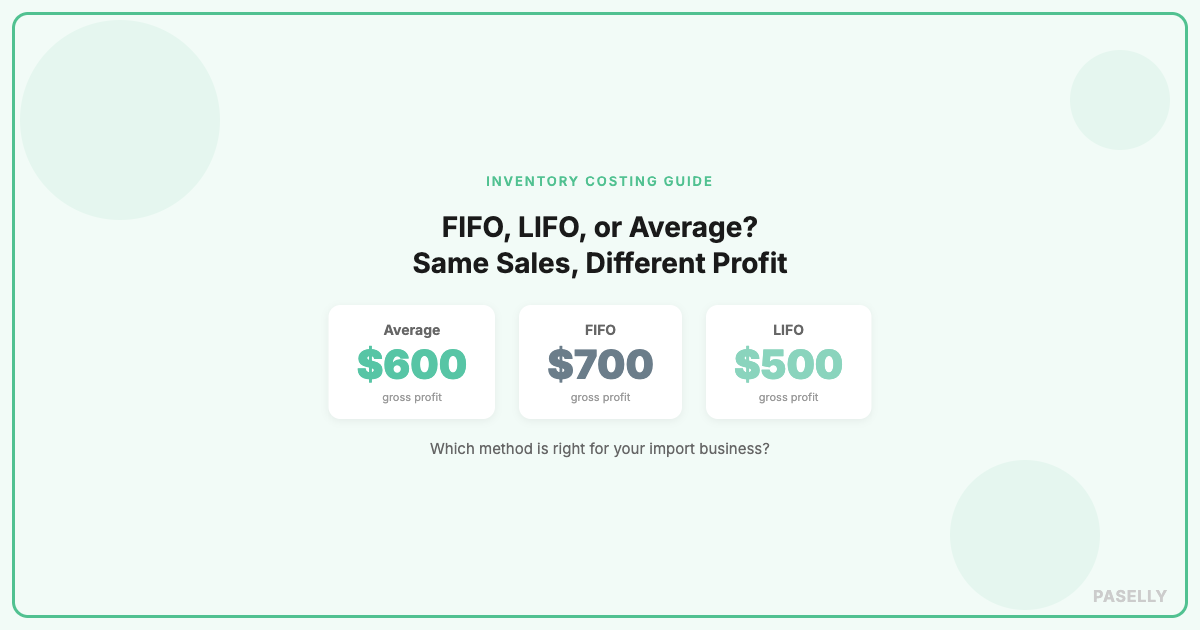
Same product. Same sales. But your reported profit ranges from $500 to $700 depending on the method — a 40% difference.
This matters for:
- Taxes — Higher profit = higher tax bill
- Pricing decisions — If you think your margin is 39% (FIFO) but it’s actually 28% (LIFO), you might underprice
- Business valuation — Investors and lenders look at your inventory value and margins
Which Method Should You Choose?
For most small importers: Weighted Average
If you’re running a small import business, weighted average is the practical choice. It’s easy to calculate, easy to explain, and doesn’t require tracking which specific units came from which shipment.
Recalculate your average cost every time you receive a new shipment:
New average = (Existing inventory value + New shipment landed cost) ÷ Total units on hand
If you need formal accounting: FIFO
If you’re growing, working with investors, or operating in a country that uses IFRS, FIFO is the standard choice. Most inventory management software supports FIFO out of the box.
If you’re US-based and want to minimize taxes: Consider LIFO
LIFO can reduce your tax bill when costs are rising, but it adds complexity and is only available under US GAAP. Talk to your accountant before committing — once you choose LIFO, switching back requires IRS approval.
Practical Tips for Import Businesses
1. Record Landed Cost Per Shipment
Every time you receive a shipment, record the full landed cost — not just the supplier invoice. Include shipping, duties, insurance, and fees. This is your input for any costing method.
2. Update Your Average After Every Shipment
If you use weighted average, don’t just calculate it once a year. Update it every time new inventory arrives. This keeps your pricing decisions based on current costs.
3. Watch for Big Cost Swings
If the yen drops 10% or a new tariff hits, your next shipment could cost significantly more. Under weighted average, this gets smoothed out. Under FIFO, the impact is delayed. Either way, you need to know it’s coming so you can adjust prices proactively.
4. Keep Documentation
Tax authorities may ask you to prove your inventory valuation method. Keep:
- Supplier invoices for each order
- Shipping and customs receipts
- Your landed cost calculation for each shipment
- A record of which method you’re using and when you started
Summary
| Method | Best For | Complexity | Allowed Under |
|---|---|---|---|
| Weighted Average | Small businesses, simplicity | Low | GAAP + IFRS |
| FIFO | Growing businesses, formal accounting | Medium | GAAP + IFRS |
| LIFO | US businesses wanting tax savings | High | US GAAP only |
Your inventory costing method is a decision that affects your profit, your taxes, and your pricing. Choose one that matches your business size and reporting needs — and apply it consistently.