If you’ve ever signed a contract in Japan and been asked to “attach a revenue stamp,” you’ve encountered one of Japan’s most confusing business customs for foreigners. Revenue stamps (収入印紙, shūnyū inshi) are how Japan collects tax on certain paper documents — and getting it wrong can cost you three times the original amount in penalties.
This guide explains exactly when you need revenue stamps, how much they cost, and how you can legally avoid them altogether.
Want to skip the stamps entirely? Jump to the digital solution.
What Are Revenue Stamps?
Revenue stamps (収入印紙, shūnyū inshi) are small adhesive stamps issued by the Japanese government. They look like postage stamps and come in denominations from 1 yen to 100,000 yen.
Their purpose is simple: Japan imposes a tax — called stamp tax (印紙税, inshi-zei) — on certain types of paper documents. To pay this tax, you purchase a revenue stamp and physically affix it to the document. The tax is considered paid once the stamp is affixed and “canceled” with a seal or signature across the stamp.
Key points for foreigners
- Stamp tax applies to paper documents only. Electronic documents are exempt.
- The tax is determined by the content of the document, not its title. A document titled “Agreement” may or may not be taxable depending on what it actually says.
- The obligation can apply to foreign individuals, foreign-owned companies, and overseas companies when they create taxable paper documents in Japan.
- If you create two signed originals of a contract (one for each party), both copies require stamps. A plain photocopy kept only for internal reference is generally not taxable. (See NTA No.7120.)
Which Documents Require a Revenue Stamp?
Japanese tax law classifies taxable documents into 20 categories. As a foreign business owner, you’ll most commonly encounter these:
Contracts (契約書)
Type 1 Documents — Real estate sales contracts, land lease contracts, loan agreements, and transport contracts.
Type 2 Documents — Service contracts (請負契約書, ukeoi keiyaku-sho). This includes construction contracts, design contracts, and any agreement where you promise to deliver a specific work product.
Type 7 Documents — Ongoing business contracts (継続的取引基本契約書). These include master service agreements, distributor agreements, and agency contracts. Flat rate: ¥4,000 regardless of contract value. However, contracts with a term of 3 months or less (with no renewal clause) are exempt.
Receipts (領収書)
Type 17 Documents — Receipts issued by a business for receiving money or securities. Receipts for sales revenue of ¥50,000 or more require a revenue stamp (receipts under ¥50,000 are tax-free). Non-sales receipts (e.g., receiving a loan repayment or deposit refund) have a separate, lower tax table. Receipts issued by non-business individuals are exempt entirely. (See NTA No.7105 for details.)
Documents you might NOT expect to be taxable
- Purchase order acceptances (注文請書, chūmon uke-sho) — A signed purchase order acceptance can be taxable when it proves a taxable contract — particularly a Type 2 contract for work or services (請負). A simple goods purchase order is not automatically taxable merely because it is signed. (See NTA No.7118.)
- Promissory notes (約束手形) — Type 3 documents, taxed based on face value.
Documents that are NOT taxable
- Quotations (見積書) — not taxable
- Delivery notes (納品書) — not taxable
- Invoices (請求書) — not taxable (they request payment, not confirm receipt)
- Electronic documents — not subject to stamp tax
However, an invoice or delivery note can become taxable as a receipt (Type 17) if it includes wording showing that money was received, such as “paid,” “settled,” or “received.”
Stamp Tax Amount Tables
Type 1 Documents (Real Estate, Land Lease, Loan, Transport Contracts)
| Contract Value | Stamp Tax |
|---|---|
| Less than ¥10,000 | Non-taxable |
| ¥10,000 – ¥100,000 | ¥200 |
| ¥100,001 – ¥500,000 | ¥400 |
| ¥500,001 – ¥1,000,000 | ¥1,000 |
| ¥1,000,001 – ¥5,000,000 | ¥2,000 |
| ¥5,000,001 – ¥10,000,000 | ¥10,000 |
| ¥10,000,001 – ¥50,000,000 | ¥20,000 |
| ¥50,000,001 – ¥100,000,000 | ¥60,000 |
| ¥100,000,001 – ¥500,000,000 | ¥100,000 |
| ¥500,000,001 – ¥1,000,000,000 | ¥200,000 |
| ¥1,000,000,001 – ¥5,000,000,000 | ¥400,000 |
| Over ¥5,000,000,000 | ¥600,000 |
| No amount stated | ¥200 |
Type 2 Documents (Service / Work Contracts)
| Contract Value | Stamp Tax |
|---|---|
| Less than ¥10,000 | Non-taxable |
| ¥10,000 – ¥1,000,000 | ¥200 |
| ¥1,000,001 – ¥2,000,000 | ¥400 |
| ¥2,000,001 – ¥3,000,000 | ¥1,000 |
| ¥3,000,001 – ¥5,000,000 | ¥2,000 |
| ¥5,000,001 – ¥10,000,000 | ¥10,000 |
| ¥10,000,001 – ¥50,000,000 | ¥20,000 |
| ¥50,000,001 – ¥100,000,000 | ¥60,000 |
| ¥100,000,001 – ¥500,000,000 | ¥100,000 |
| ¥500,000,001 – ¥1,000,000,000 | ¥200,000 |
| ¥1,000,000,001 – ¥5,000,000,000 | ¥400,000 |
| Over ¥5,000,000,000 | ¥600,000 |
| No amount stated | ¥200 |
Receipts (Type 17 Documents — Sales Revenue)
| Receipt Amount | Stamp Tax |
|---|---|
| Less than ¥50,000 | Non-taxable |
| ¥50,000 – ¥1,000,000 | ¥200 |
| ¥1,000,001 – ¥2,000,000 | ¥400 |
| ¥2,000,001 – ¥3,000,000 | ¥600 |
| ¥3,000,001 – ¥5,000,000 | ¥1,000 |
| ¥5,000,001 – ¥10,000,000 | ¥2,000 |
| ¥10,000,001 – ¥20,000,000 | ¥4,000 |
| ¥20,000,001 – ¥30,000,000 | ¥6,000 |
| ¥30,000,001 – ¥50,000,000 | ¥10,000 |
| ¥50,000,001 – ¥100,000,000 | ¥20,000 |
| ¥100,000,001 – ¥200,000,000 | ¥40,000 |
| ¥200,000,001 – ¥300,000,000 | ¥60,000 |
| ¥300,000,001 – ¥500,000,000 | ¥100,000 |
| ¥500,000,001 – ¥1,000,000,000 | ¥150,000 |
| Over ¥1,000,000,000 | ¥200,000 |
Ongoing Business Contracts (Type 7 Documents)
Flat rate: ¥4,000 — regardless of contract value.
The Outsourcing Contract Trap
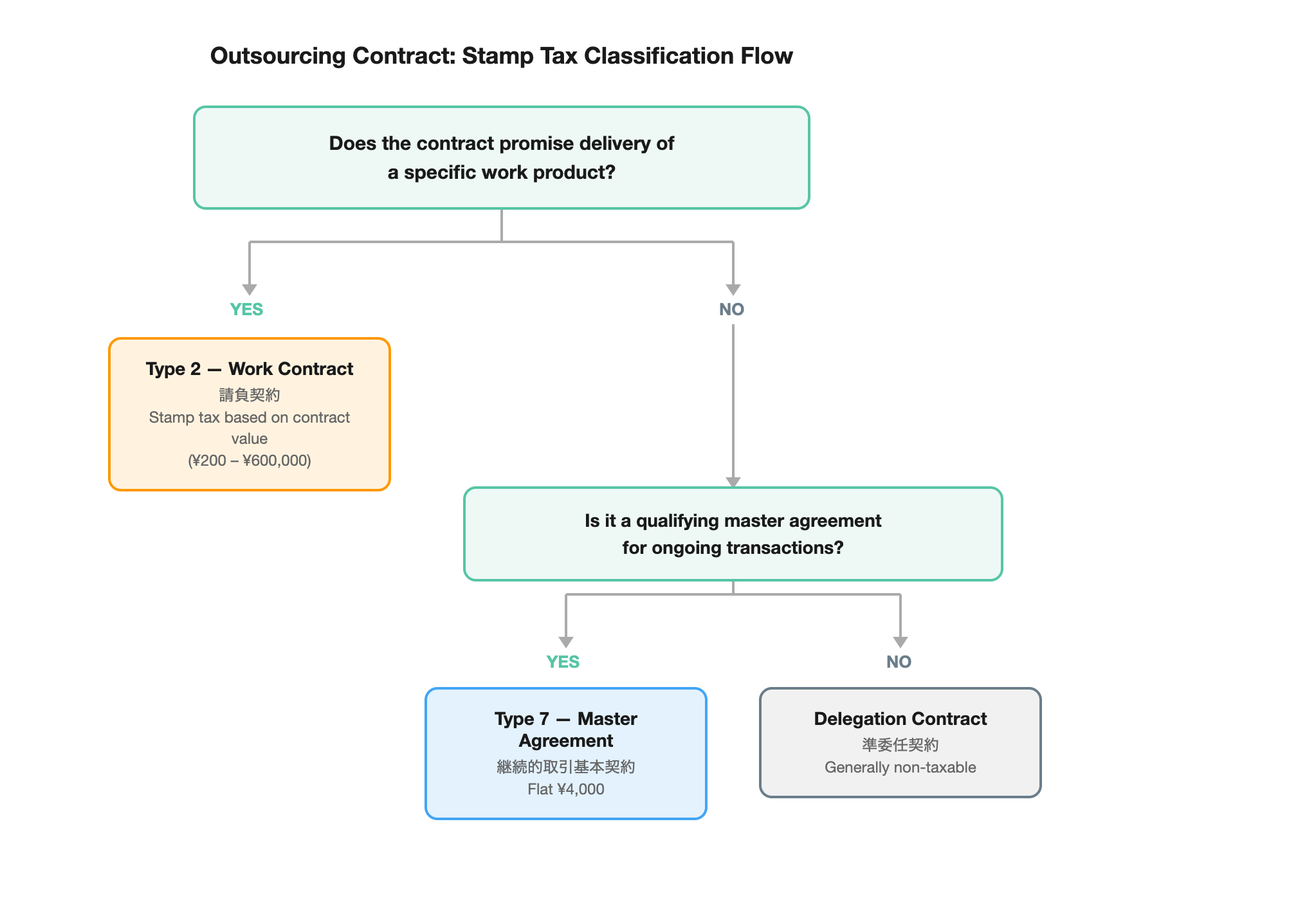
If you’re outsourcing work in Japan — hiring freelancers, agencies, or subcontractors — the stamp tax on your contract depends on how the agreement is classified:
Classification 1: Work-for-hire contract (請負, ukeoi)
If the contract promises delivery of a specific work product (a website, a design, a report), it’s classified as a Type 2 document. Stamp tax is based on the contract value (see table above).
Example: “Contractor will deliver a completed website by March 31” → Type 2, taxed by value.
Classification 2: Delegation contract (準委任, jun-inin)
If the contract is only for ongoing services without a specific deliverable — such as general consulting or advisory work — it is often treated as a delegation contract and may be non-taxable. However, check whether it falls into Type 7 or another taxable category (see Classification 3 below).
Example: “Consultant will provide marketing advice for 6 months” → Often non-taxable as a delegation contract, but verify it doesn’t qualify as a Type 7 master agreement.
Classification 3: Master service agreement (基本契約, kihon keiyaku)
A master agreement can be a Type 7 document if it is a basic contract for repeated transactions that falls within the categories specified by law — such as continuing sales, transport, contract work, certain agency/entrusted business arrangements, or certain finance, securities, or insurance agreements. Flat tax: ¥4,000.
For common business-to-business sales, transport, or work contracts, setting even one shared transaction term — such as subject matter, quantity, unit price, payment method, damages, or resale price — can be enough to qualify as Type 7. Contracts with a term of 3 months or less (with no renewal clause) are exempt.
The rules vary by contract category — see NTA No.7104 for the full classification criteria.
How Consumption Tax Display Affects Stamp Tax
Here’s a practical tip that can cut your stamp tax in half.
For Type 1 contracts, Type 2 contracts, and Type 17 receipts, if you clearly separate the consumption tax amount on the document, only the pre-tax amount is used for stamp tax calculation. (See NTA No.7124.)
This rule does not apply to Type 7 master agreements or other document types. It also does not apply if the document issuer is a consumption-tax-exempt business (免税事業者) — since exempt businesses cannot charge consumption tax, there is no tax amount to separate.
Example: A ¥11,000,000 service contract (Type 2)
Scenario A — Document states: “Contract amount: ¥11,000,000 (tax included)”
→ Stamp tax is based on ¥11,000,000 → ¥20,000
Scenario B — Document states: “Contract amount: ¥10,000,000 + Consumption tax: ¥1,000,000”
→ Stamp tax is based on ¥10,000,000 → ¥10,000
Same contract, same total — but half the stamp tax just by separating the consumption tax line.
For Type 1, Type 2, and Type 17 documents, always itemize the consumption tax separately on your paper documents.
Where to Buy Revenue Stamps
Revenue stamps are available at:
- Post offices (郵便局) — All denominations available. The most reliable option.
- Convenience stores — Usually stock ¥200 stamps only (for receipts). Larger denominations may not be available.
- Legal affairs bureaus (法務局) — All denominations.
- Some tobacco shops — Limited selection.
At post office counters, revenue stamps are not eligible for cashless payment — bring cash. Other retailers may have their own payment rules.
Available denominations
1, 2, 5, 10, 20, 30, 40, 50, 60, 80, 100, 120, 200, 300, 400, 500, 600, 1,000, 2,000, 3,000, 4,000, 5,000, 6,000, 8,000, 10,000, 20,000, 30,000, 40,000, 50,000, 60,000, and 100,000 yen.
How to Apply and Cancel Stamps
Step 1: Affix the stamp
Peel and stick the revenue stamp onto the document. There’s no legally required position, but it’s customary to place it in the upper-left margin of the first page or near the signature area.
Step 2: Cancel the stamp (消印, keshi-in)
This is critical. You must “cancel” the stamp by pressing your seal (印鑑, inkan) or writing your signature across the border of the stamp and the document. This prevents the stamp from being peeled off and reused.
- A company seal (角印 or 丸印) across the stamp is the most common method.
- A handwritten signature also works.
- The cancellation must clearly overlap both the stamp and the document surface.
If you forget to cancel the stamp, you may face a penalty equal to the face value of the uncanceled stamp (separate from the 3x non-payment penalty — see Penalties below).
Penalties for Non-Compliance
Japan takes stamp tax seriously. If you fail to affix the required revenue stamp:
Penalty tax (過怠税, katai-zei)
- Standard penalty: 3 times the original stamp tax amount. If you should have paid ¥10,000 in stamps, the penalty is ¥30,000 (¥10,000 original + ¥20,000 penalty).
- Self-reported before audit: If you report the missing stamps to the tax office yourself (before a tax audit discovers it), the penalty is reduced to 1.1 times the original amount.
- Stamp affixed but not canceled: If you attached the stamp but did not cancel it properly, the penalty is the face value of the uncanceled stamp — not the 3x non-payment penalty. (See NTA No.7131.)
What a penalty does NOT do
- The underlying contract or receipt remains legally valid even without the stamp. The stamp tax is a tax obligation, not a validity requirement.
- However, during a tax audit (税務調査), missing stamps will be flagged and penalties applied.
Go Digital, Skip the Stamps
Here’s the most important takeaway from this entire guide:
Electronic documents are completely exempt from stamp tax.
This isn’t a loophole — it’s explicitly stated in Japanese tax law. The stamp tax applies only to “paper documents” (文書). Contracts signed electronically, invoices sent as PDFs, and receipts issued digitally are all outside the scope of stamp tax.
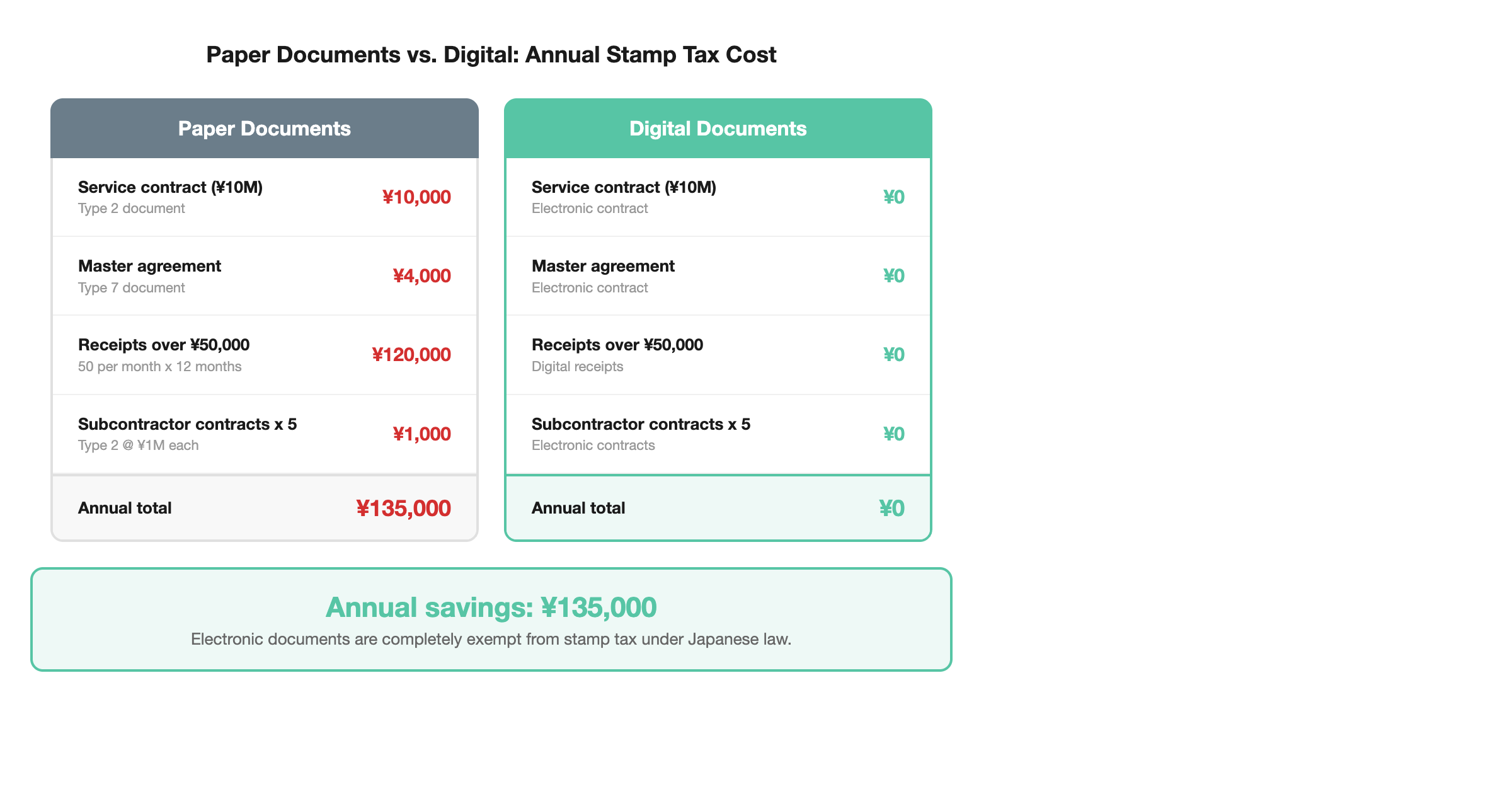
For businesses that issue dozens of contracts and receipts, the annual savings can easily reach hundreds of thousands of yen.
FAQ
Do I need a revenue stamp on a purchase order (注文書)?
Generally, no. A purchase order (注文書, chūmon-sho) issued by the buyer is not taxable. However, a purchase order acceptance (注文請書, chūmon uke-sho) can be taxable if it proves a taxable contract — particularly a Type 2 contract for work or services. A signed acceptance for a simple goods sale is not automatically taxable.
I’m making two copies of a contract — one for each party. Do both need stamps?
Yes — when both are signed originals (executed documents created to prove the contract). Each is an independent taxable document, so if the stamp tax is ¥10,000, you’ll need ¥20,000 in total. A plain photocopy kept for internal reference is generally not taxable. This is another reason to consider digital contracts — no copies, no stamps.
Does a receipt for credit card payment need a stamp?
No — as long as the receipt clearly states “credit card payment” or “no cash received” (クレジットカード利用). Since no cash or monetary equivalent changed hands, it’s not a Type 17 taxable document.
What about receipts from e-money or QR code payments?
It depends on the payment service structure. For credit cards, the rule is straightforward because the card company settles later — no money changes hands at the point of receipt. But for some e-money and QR code payment services, the NTA’s position is that money or securities may be considered received at the time of the transaction, depending on how the settlement works behind the scenes. Consult a tax advisor or check the NTA’s guidance on QR code payment receipts for your specific payment service.
I’m a foreign company without a Japan office. Do stamp tax rules apply to me?
Stamp tax applies based on where the taxable document is created (作成), not the nationality of the parties or where the transaction takes place. If you sign or execute a taxable paper document within Japan, stamp tax applies — even if you’re a foreign company. Conversely, a contract drafted and signed outside Japan is not subject to Japanese stamp tax, even if it relates to a Japanese transaction or is later stored in Japan. (See NTA guidance on documents created abroad.)
Can I use a foreign-currency amount on the contract?
Yes. If the contract amount is shown in foreign currency, the stamp tax is determined by converting it into yen using the basic foreign exchange rate or arbitrated foreign exchange rate (基準外国為替相場 or 裁定外国為替相場) on the document creation date, as published by the Bank of Japan. (See NTA No.7122.)
Sources
This guide is based on official National Tax Agency (国税庁) publications:
- NTA No.7140 — Stamp Tax Amount Table (Part 1)
- NTA No.7141 — Stamp Tax Amount Table (Part 2)
- NTA No.7105 — Receipts (Type 17 Documents)
- NTA No.7108 — Reduced Rates for Construction Contracts
- NTA No.7124 — Consumption Tax and Stamp Tax Calculation
- NTA No.7118 — Treatment of Order Forms and Acceptances
- NTA No.7120 — Copies, Duplicates, and Transcripts of Contracts
- NTA No.7122 — Document Stated Amounts (Foreign Currency)
- NTA No.7104 — Continuing Business Contracts (Type 7)
- NTA No.7131 — Penalties for Unpaid Stamp Tax
- NTA — QR Code Payment Receipts and Stamp Tax
- NTA — Documents Created Outside Japan